How Vacuum Packaging Machines Work: A Step-by-Step Guide
Vacuum packaging machines are packaging systems that remove air from a package before sealing it. By reducing the amount of air surrounding the product.
Vacuum packaging machines are widely used in food processing, pharmaceuticals, medical products, electronics, industrial components, and other applications. Machine designs range from compact chamber systems to automated industrial lines that integrate product handling, vacuum generation, sealing, cooling, and inspection.
Why Vacuum Packaging Machines Matter
Air inside a package can contribute to oxidation, moisture-related changes, and deterioration of certain products. Vacuum packaging removes much of this air before the package is sealed.
The technology is particularly useful when a product requires a controlled package environment. However, vacuum packaging does not replace appropriate sanitation, temperature control, or other product-specific preservation requirements.
Important considerations include:
- Product dimensions
- Product characteristics
- Packaging material
- Required vacuum level
- Sealing requirements
- Production volume
- Package size
- Film thickness
- Automation level
- Inspection requirements
How Vacuum Packaging Machines Work
Although machine configurations differ, the basic process involves loading the product, positioning the packaging material, removing air, sealing the package, and releasing the vacuum.
1. Product Preparation
The product is prepared according to the packaging process.
Products can include food items, medical components, electronic parts, industrial components, and other products suitable for vacuum packaging.
The package size should provide enough material around the product to create a reliable seal.
2. Package Loading
The product is placed inside a suitable vacuum-compatible pouch, bag, tray, or other packaging structure.
The open end of the package is positioned correctly within the sealing area.
For automated equipment, conveyors, feeders, robotic systems, or product loading mechanisms can transfer products into the packaging station.
3. Chamber Closure
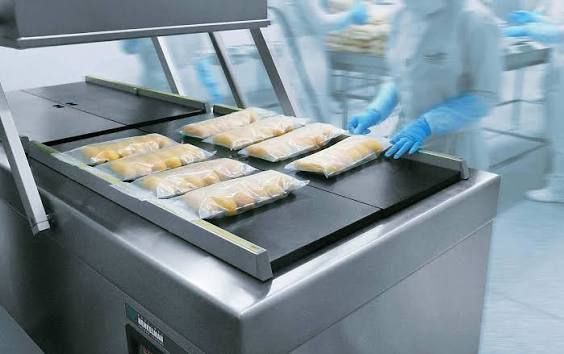
In a chamber vacuum machine, the filled pouch is positioned inside a vacuum chamber.
The chamber lid then closes to create an enclosed space.
External vacuum systems can use a nozzle or suction mechanism to remove air directly from the package without enclosing the entire package inside a chamber.
4. Air Removal
The vacuum pump removes air from the chamber or package.
The machine continues the vacuum cycle until the programmed pressure level or cycle condition is reached.
Vacuum control depends on:
- Pump capacity
- Package volume
- Product characteristics
- Packaging material
- Desired vacuum level
- Machine configuration
Certain products require controlled vacuum levels because excessive vacuum can deform delicate items or compress soft products.
5. Sealing
Once the required vacuum condition is achieved, the machine seals the package.
A heated sealing bar generally applies controlled temperature and pressure to bond compatible layers of the packaging material.
Important sealing parameters include:
- Sealing temperature
- Sealing pressure
- Sealing time
- Seal width
- Packaging material compatibility
6. Cooling
After the seal is formed, a short cooling stage can help stabilize the sealed area.
Controlled cooling allows the sealing layers to solidify before the package is exposed to normal atmospheric pressure.
7. Atmospheric Pressure Release
Once the seal is sufficiently stable, the machine releases the vacuum from the chamber.
Atmospheric pressure then returns around the package.
The completed package can be removed manually or transferred automatically to downstream equipment.
8. Inspection
The finished package can be inspected for seal quality, leaks, wrinkles, damage, and other irregularities.
Automated systems may use sensors or vision inspection equipment to detect packaging defects.
Types of Vacuum Packaging Machines
Chamber Vacuum Packaging Machines
Chamber machines place the entire package inside a vacuum chamber before air removal and sealing.
They are commonly used for food products, industrial components, and other applications requiring controlled vacuum and sealing.
External Vacuum Packaging Machines
External systems remove air directly from a pouch using a vacuum nozzle or similar mechanism.
The package remains outside the main vacuum chamber, making this configuration suitable for certain lower-volume packaging applications.
Automatic Vacuum Packaging Machines
Automatic systems can integrate product feeding, pouch handling, vacuum generation, sealing, and package discharge.
They are designed for production environments requiring repeated and synchronized packaging cycles.
Double-Chamber Vacuum Machines
Double-chamber systems contain two vacuum chambers that can alternate between loading and vacuum-sealing cycles.
While one chamber is being unloaded or loaded, the other can perform the vacuum and sealing operation.
This arrangement can support continuous operator workflow.
Vacuum Tray Packaging Machines
Tray-based systems remove air from a tray or package before sealing a film over the product.
Depending on the equipment and packaging method, these machines can produce vacuum skin packs, modified-atmosphere packages, or other sealed tray formats.
Comparison of Vacuum Packaging Machines
| Machine Type | Main Method | Typical Characteristic |
|---|---|---|
| Chamber vacuum machine | Entire pouch inside chamber | Controlled vacuum cycle |
| External vacuum machine | Nozzle removes air | Flexible pouch handling |
| Automatic system | Integrated packaging stages | Higher automation |
| Double-chamber machine | Alternating chambers | Continuous workflow |
| Tray vacuum machine | Air removal from tray | Rigid or semi-rigid packs |
Main Components of Vacuum Packaging Machines
A typical vacuum packaging system can contain several important components.
| Component | Function |
|---|---|
| Vacuum pump | Removes air |
| Vacuum chamber | Creates controlled vacuum environment |
| Sealing bar | Forms package seal |
| Heating element | Provides sealing heat |
| Pressure system | Applies sealing force |
| Vacuum sensor | Monitors vacuum conditions |
| Control panel | Sets machine parameters |
| Cooling system | Stabilizes seals |
| Conveyor | Transfers packages |
| Inspection system | Checks package quality |
Packaging Materials Used
Vacuum packaging requires materials capable of maintaining package integrity after air removal.
Common structures can include:
- Multilayer plastic films
- Barrier films
- Vacuum pouches
- Thermoformed packaging
- Vacuum-compatible trays
- Specialized medical packaging materials
Material selection depends on barrier requirements, puncture resistance, sealing characteristics, product geometry, and storage conditions.
Factors for Selecting Vacuum Packaging Machines
Product Characteristics
Consider product size, shape, rigidity, moisture content, and sensitivity to pressure.
Package Format
Determine whether the application requires pouches, bags, trays, thermoformed packs, or another packaging structure.
Vacuum Requirements
The required vacuum level depends on the product and packaging objective. Not every product requires the same degree of air removal.
Production Volume
Higher production volumes may require automatic loading, multiple sealing stations, conveyors, and integrated inspection systems.
Seal Quality
The equipment should provide consistent temperature, pressure, and sealing time for the selected packaging material.
Machine Configuration
Evaluate chamber dimensions, pump capacity, sealing-bar configuration, cycle time, controls, and available installation space.
Applications of Vacuum Packaging Machines
Vacuum packaging systems are used across multiple industries.
Common applications include:
- Meat and seafood packaging
- Cheese and other food products
- Prepared foods
- Medical products
- Pharmaceutical components
- Electronics
- Industrial components
- Hardware
- Precision parts
- Laboratory products
Frequently Asked Questions
What are vacuum packaging machines?
Vacuum packaging machines are systems that remove air from a package before sealing it. They can use chambers, vacuum nozzles, or specialized tray systems depending on the package format.
How does a vacuum packaging machine work?
A typical machine places the product inside a suitable package, removes air using a vacuum pump, seals the package, cools the seal, releases the vacuum, and transfers the finished package for inspection or further handling.
What is a chamber vacuum packaging machine?
A chamber vacuum machine places the entire pouch inside a sealed chamber. The machine removes air from the chamber and pouch before forming the package seal.
What materials can be used for vacuum packaging?
Vacuum-compatible pouches, multilayer films, barrier materials, thermoformed structures, and specialized trays can be used depending on the product and packaging requirements.
Does vacuum packaging preserve every type of product?
Vacuum packaging can help protect suitable products from air exposure, but it does not replace product-specific storage, sanitation, temperature control, or other preservation requirements.
Conclusion
Vacuum packaging machines combine air removal, controlled sealing, cooling, and package handling to create sealed packages with reduced internal air. Chamber, external, automatic, double-chamber, and tray-based systems provide different approaches for different products and production environments.
Selecting the appropriate machine requires consideration of product characteristics, package format, vacuum requirements, sealing materials, production volume, and quality controls. Understanding each stage of the process provides a useful foundation for evaluating vacuum packaging equipment and developing an appropriate packaging workflow.