Apache Hive for Big Data Analytics: Features, Architecture, and Benefits
Apache Hive for big data analytics provides a powerful way to query, manage, and analyze large datasets stored in distributed data environments.
As organizations generate increasing amounts of information from applications, transactions, websites, sensors, and business systems, traditional database solutions may struggle to process all the data efficiently. Apache Hive helps address this challenge by providing a SQL-like interface for working with large datasets, particularly within the Apache Hadoop ecosystem.
Developed initially to make large-scale data analysis more accessible, Apache Hive allows analysts and data engineers to write queries using a language called HiveQL. These queries can be translated into distributed processing jobs, allowing data to be analyzed across a cluster rather than on a single machine.
Apache Hive is widely associated with data warehousing, batch analytics, reporting, and large-scale data transformation. Understanding its architecture, features, advantages, and limitations helps organizations determine how it fits into their big data infrastructure.
What Is Apache Hive?
Apache Hive is an open-source data warehouse system designed to query and analyze large datasets stored in distributed storage environments. It provides a SQL-like query language called HiveQL, enabling users familiar with relational databases to work with large-scale data without writing every distributed processing operation manually.
Hive was originally developed at Facebook to simplify data analysis on Hadoop. It later became an Apache Software Foundation project.
Unlike a traditional relational database, Hive is designed primarily for analytical workloads rather than high-volume transactional processing. It can organize data into tables, partitions, and buckets while using metadata to describe the structure of datasets.
Hive commonly works with the Hadoop Distributed File System (HDFS), although it can also operate with other compatible storage systems.
For example, a retail organization may use Hive to analyze millions of sales records, identify purchasing trends, compare regional performance, and prepare data for business intelligence dashboards.
Why Apache Hive Is Important for Big Data Analytics
Big data analytics involves processing large and complex datasets to identify patterns, measure performance, and support business decisions.
Traditional database systems may require substantial resources or specialized architectures to handle certain large-scale analytical workloads. Apache Hive helps by providing a familiar query interface and integrating with distributed processing technologies.
1. SQL-Based Data Analysis
HiveQL resembles SQL, making it easier for data analysts and database professionals to work with large datasets using familiar query concepts.
Users can perform operations such as filtering, joining, grouping, aggregating, and transforming data without manually implementing every distributed computation.
2. Distributed Data Processing
Hive can translate analytical queries into execution plans that run across distributed processing infrastructure.
Depending on the configuration and supported execution engine, these workloads may use Apache Tez or Apache Spark. Older and legacy deployments may use MapReduce.
Distributed execution allows large datasets to be processed across multiple machines.
3. Support for Large Datasets
Hive is designed for analytical workloads involving large volumes of structured and semi-structured data.
Organizations can use it to process historical records, event logs, customer activity, transaction histories, and other datasets that may be too large or expensive to analyze efficiently with conventional single-machine tools.
4. Integration With the Hadoop Ecosystem
Hive works with technologies such as HDFS and the Hadoop ecosystem's metadata and processing components.
It can also integrate with data ingestion tools, workflow schedulers, distributed storage, and business intelligence platforms, depending on the deployment architecture.
This makes Hive useful as part of a broader data engineering and analytics platform.
Key Features of Apache Hive
Apache Hive provides several capabilities that support large-scale data analysis and data warehousing.
HiveQL Query Language
HiveQL provides a SQL-like interface for defining tables and querying data.
Analysts can write queries using familiar statements such as SELECT, WHERE, GROUP BY, JOIN, and ORDER BY. Hive then creates an execution plan to process the requested operations.
Although HiveQL resembles SQL, not every SQL feature or behavior is identical across database systems. Query compatibility depends on the Hive version and supported functionality.
Schema-on-Read
Hive commonly uses a schema-on-read approach. Instead of requiring every dataset to be transformed into a rigid database structure before storage, Hive applies table definitions and data interpretation rules when the data is queried.
This can simplify the storage of large datasets in distributed file systems.
However, data quality checks and consistent schema management remain important for reliable analysis.
Partitioning
Partitioning divides a table into smaller logical sections based on selected column values.
For example, a sales table may be partitioned by year, month, or region. When a query filters on a partition column, Hive may be able to scan only the relevant partitions instead of processing the entire table.
Effective partition design can significantly improve query performance.
Bucketing
Bucketing distributes table records into a predefined number of files or groups based on a hashing function applied to selected columns.
This organization can help certain joins and sampling operations, depending on the query, table layout, and execution plan.
Partitioning and bucketing serve different purposes and are often used together when appropriate.
Multiple File Formats
Hive supports a range of data storage formats, including text files, SequenceFiles, Avro, ORC, and Parquet, depending on the version and configuration.
Columnar formats such as ORC and Parquet can improve analytical performance by enabling efficient compression and reducing the amount of data read for certain queries.
Extensibility
Hive supports user-defined functions that allow developers to implement additional processing logic beyond built-in operations.
These functions can help address specialized transformation and analysis requirements, subject to the execution environment and deployment configuration.
Apache Hive Architecture
Apache Hive uses several components to receive queries, manage metadata, plan execution, and return results.
Understanding these components helps explain how a SQL-like query can operate on large datasets distributed across multiple machines.
1. User Interface and Clients
Users interact with Hive through supported interfaces and client applications.
These may include command-line tools, JDBC or ODBC connections, and applications that submit Hive queries through services such as HiveServer2.
Business analysts, data engineers, and automated applications can use these interfaces to access analytical data.
2. Driver
The driver coordinates query processing.
It receives the query, manages the query lifecycle, coordinates the compiler and execution process, and helps return results to the client.
3. Compiler and Query Optimizer
The compiler parses the query, checks its structure and semantics, and uses metadata to understand the referenced tables and columns.
The optimizer then develops an execution plan intended to process the query efficiently. Optimization can include operations such as predicate pushdown, partition pruning, and join planning when supported by the query and storage configuration.
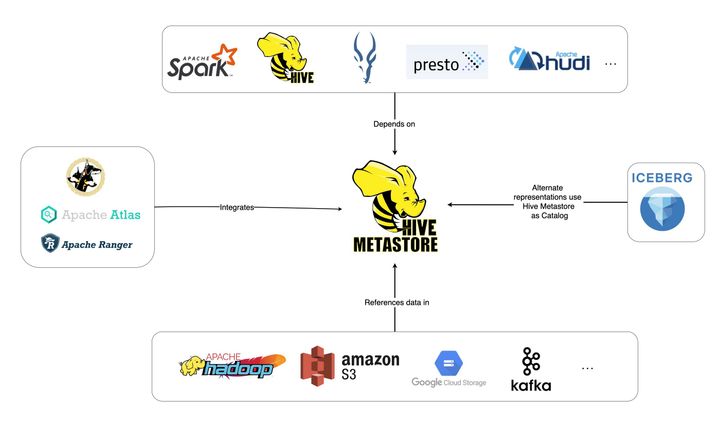
4. Metastore
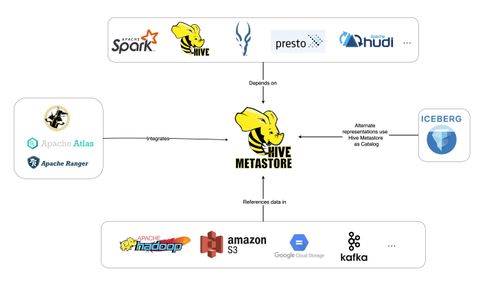
The Hive Metastore stores metadata about tables, columns, partitions, storage locations, and related data structures.
It generally does not store the actual contents of the analytical tables. Instead, it provides the information Hive needs to interpret and locate data in the underlying storage system.
The Metastore is an important component of Hive's data management architecture.
5. Execution Engine
The execution engine coordinates the processing tasks generated from the query plan.
Depending on the deployment, Hive may use Apache Tez, Apache Spark, or MapReduce for query execution.
These engines distribute supported operations across the available computing resources.
6. Distributed Storage
Hive data may be stored in HDFS or other supported storage systems.
The data can be organized into directories, partitions, and files using formats suitable for large-scale analytical processing.
The architecture allows users to query large datasets without manually managing the execution of every distributed task.
How Apache Hive Works
The Hive query processing workflow typically follows several stages.
Step 1: Submit a query. A user or application sends a HiveQL statement through a supported client interface.
Step 2: Parse and validate. Hive checks the query syntax and verifies references to tables, columns, and functions.
Step 3: Retrieve metadata. Hive consults the Metastore to understand the table definitions, partition information, and storage locations.
Step 4: Optimize the query. The query optimizer determines an execution plan based on available metadata and applicable optimization rules.
Step 5: Execute the plan. The selected execution engine processes the required operations against the distributed data.
Step 6: Return results. Hive makes the query results available to the client or application.
The exact execution workflow depends on the Hive version, execution engine, query type, and deployment configuration.
Practical Example of Apache Hive for Big Data Analytics
Consider a retail company that stores millions of sales transactions in a distributed data environment. Each record contains information such as the transaction date, product category, region, and sales amount.
The company wants to calculate monthly revenue for each product category.
A simplified HiveQL query might look like this:
SELECT
    product_category,
    MONTH(transaction_date) AS sales_month,
    SUM(sales_amount) AS total_revenue
FROM sales_transactions
WHERE YEAR(transaction_date) = 2026
GROUP BY
    product_category,
    MONTH(transaction_date)
ORDER BY
    sales_month,
    total_revenue DESC;
This query groups sales records by product category and month, calculates total revenue, and sorts the results.
In a large dataset, Hive can distribute the required processing across a cluster rather than requiring all records to be processed on one machine.
For production workloads, performance also depends on table design, partitioning, file formats, data quality, and the execution engine. If the table is partitioned by year, for example, the query can be designed to take advantage of that layout.
Applications of Apache Hive in Big Data Analytics
Apache Hive can support a variety of analytical tasks across industries.
Business Intelligence and Reporting
Organizations use Hive to aggregate historical business data and prepare datasets for reporting tools.
Examples include revenue analysis, customer segmentation, sales performance, and operational reporting.
Log and Event Analysis
Websites, mobile applications, and enterprise systems generate large volumes of event records.
Hive can help process these records to analyze user activity, application performance, traffic patterns, and system behavior.
Financial Data Analysis
Financial institutions can use Hive-based data pipelines to aggregate transaction histories, analyze customer behavior, calculate performance indicators, and prepare historical datasets for reporting.
Sensitive financial workloads require appropriate access controls, data governance, and compliance measures.
Customer Analytics
Businesses can combine customer interactions, purchase histories, and engagement records to understand behavior and identify trends.
Hive is useful when analysis requires scanning and aggregating large historical datasets.
Data Lake Processing
Hive can provide a SQL-oriented layer for analyzing datasets stored in a data lake.
Depending on the environment, it can support data preparation, transformation, and the creation of structured analytical tables used by downstream applications.
Benefits of Apache Hive
Apache Hive offers several advantages for organizations managing large-scale analytical workloads.
Scalability
Hive can work with distributed processing infrastructure to analyze datasets that exceed the practical capacity of a single machine.
Its scalability depends on cluster resources, storage architecture, query complexity, and system configuration.
Familiar Query Interface
HiveQL reduces the need for analysts to write low-level distributed processing code for common analytical tasks.
This can make large-scale data analysis more accessible to teams with SQL experience.
Cost-Effective Data Storage
Hive can analyze data stored in distributed storage systems and use efficient file formats to reduce storage requirements.
The overall cost depends on infrastructure, resource consumption, data retention, and operational complexity.
Support for Batch Analytics
Hive is well suited to workloads that process large volumes of data to produce reports, summaries, and transformed datasets.
These jobs may run on scheduled intervals or as part of broader data pipelines.
Integration With Data Platforms
Hive can serve as a component in data engineering architectures that combine ingestion, storage, distributed processing, scheduling, and business intelligence tools.
Challenges and Limitations of Apache Hive
Although Hive is valuable for big data analytics, it is not the best choice for every workload.
Query Latency
Hive has traditionally been optimized for batch-oriented analytical processing rather than low-latency transactional queries.
Although modern configurations and execution engines can improve performance, some interactive applications may be better served by systems specifically designed for low-latency analytics.
Resource Requirements
Large queries can consume substantial CPU, memory, and storage bandwidth.
Poorly optimized joins, inefficient table layouts, and excessive data scans can increase processing time and infrastructure costs.
Complex Configuration
Setting up and maintaining a Hive environment may require expertise in distributed storage, query execution, metadata management, security, and cluster operations.
Limited Suitability for Transactional Workloads
Hive is not generally intended to replace an online transaction processing database for applications requiring frequent, low-latency inserts, updates, and individual record lookups.
Some Hive versions support transactional table capabilities under specific conditions, but these do not make Hive a universal substitute for a conventional transactional database.
Data Management Complexity
Large analytical environments need consistent metadata, access permissions, schema definitions, and data quality controls.
Without effective governance, users may encounter duplicate datasets, inconsistent definitions, or unreliable analytical results.
Best Practices for Optimizing Apache Hive Performance
Organizations can improve Hive query performance through careful data organization, query design, and resource management.
Use Appropriate File Formats
Columnar formats such as ORC and Parquet are often effective for analytical workloads because they support compression and selective column reads.
The best format depends on query patterns, compatibility requirements, and the surrounding data platform.
Apply Partitioning Carefully
Partition large tables using columns that frequently appear in filters, such as date or region.
Avoid creating excessive numbers of tiny partitions, as metadata overhead and file management can become significant.
Optimize Queries
Select only the columns needed for analysis and filter records as early as practical.
Review join conditions, aggregation logic, and execution plans to identify expensive operations.
Reduce Small Files
A large number of small files can increase metadata and task-management overhead.
Where appropriate, compact files into larger units to improve scanning efficiency and reduce overhead.
Monitor Resource Utilization
Track query duration, memory use, CPU consumption, data scanned, and execution failures.
Performance monitoring helps teams identify inefficient queries and determine whether improvements are needed in the query design, data layout, or cluster configuration.
Apache Hive vs. Traditional Databases
Apache Hive and traditional relational databases serve different primary purposes.
Traditional relational databases are commonly designed for applications that need frequent transactions, fast record-level operations, and strict transactional behavior.
Hive is primarily intended for large-scale analytical processing, particularly batch workloads involving substantial amounts of distributed data.
For example, an online banking application may use a transactional database to update an account balance immediately, while a Hive-based analytics platform may process historical transaction records to calculate monthly trends.
The technologies can complement one another within the same organization. The appropriate choice depends on data volume, latency requirements, transaction needs, and the nature of the workload.
The Future of Apache Hive in Big Data Analytics
The big data ecosystem continues to evolve as organizations adopt cloud storage, lakehouse architectures, distributed SQL engines, and real-time processing platforms.
Apache Hive remains relevant in environments that depend on Hadoop-based data warehouses, established Hive tables, and large-scale batch processing.
Its role increasingly depends on how well it integrates with newer storage formats, metadata services, governance tools, and analytical technologies.
Organizations may combine Hive with other platforms to support different requirements, using it for established batch workloads while relying on specialized systems for streaming analytics or low-latency queries.
The long-term value of Hive therefore depends on the existing data architecture, operational requirements, and the benefits of maintaining or modernizing current infrastructure.
Conclusion
Apache Hive for big data analytics provides a SQL-based approach to querying and managing large datasets in distributed environments. Its support for HiveQL, partitioning, bucketing, multiple file formats, and distributed execution makes it useful for data warehousing, batch processing, reporting, and large-scale data transformation.
Understanding Hive's architecture and query processing workflow helps organizations design more efficient analytical pipelines. At the same time, its limitations in low-latency and transactional workloads must be considered when selecting the right technology.