How Coating Application Equipment Works: A Step-by-Step Guide
Coating application equipment plays an important role in applying paints, protective coatings, and specialized finishes to industrial surfaces.
The right equipment helps control coating thickness, coverage, transfer efficiency, and surface consistency.
From spray guns and pumps to automated coating lines, different systems are designed for different materials, substrates, and production requirements. Understanding how these systems work makes it easier to identify the appropriate equipment for a particular application.
Why Coating Application Equipment Matters
Industrial coatings are often required to provide protection against corrosion, chemicals, moisture, abrasion, heat, and environmental exposure. Application quality can directly affect how effectively a coating performs after curing.
Poor application can lead to uneven thickness, overspray, runs, inadequate coverage, or adhesion problems. Properly selected industrial coating application equipment helps maintain consistent application conditions and can improve production efficiency.
Key factors include:
- Coating viscosity
- Required film thickness
- Surface type and geometry
- Application speed
- Production volume
- Transfer efficiency
- Required finish quality
- Manual or automated operation
Main Types of Coating Application Equipment
Different coating technologies require different application methods. The most suitable option depends on the coating formulation, substrate, and production environment.
Spray Coating Equipment
Spray systems atomize liquid coating into small droplets and direct them toward the surface. Common technologies include air spray, airless spray, and air-assisted airless systems.
Spray equipment is widely used for large surfaces, complex components, machinery, structural steel, and industrial assemblies.
Powder Coating Equipment
Powder coating systems use electrically charged powder particles that are attracted to a grounded workpiece. The coated component is then heated in a curing oven so the powder melts and forms a continuous film.
A typical powder coating line may include surface preparation equipment, a coating booth, powder application equipment, recovery systems, and a curing oven.
Dipping Systems
Dipping involves immersing components in a liquid coating material. The coating adheres to the surface before the component is removed and allowed to drain or undergo subsequent curing.
This method can be useful for components with complex shapes where complete surface coverage is required.
Roller and Curtain Coating Systems
Roller coating uses rotating rollers to transfer coating material onto a surface. Curtain coating creates a continuous curtain of coating through which components pass.
These methods can provide controlled and uniform application for suitable flat or continuously processed materials.
How Coating Application Equipment Works
Although equipment designs vary, most coating systems follow a series of basic steps.
1. Surface Preparation
Before coating begins, the substrate must be properly prepared. Cleaning can remove oil, grease, dust, rust, scale, and other contaminants.
Depending on the application, preparation may involve abrasive blasting, chemical treatment, mechanical cleaning, or other processes.
2. Coating Preparation
The coating material is prepared according to its technical requirements. This may involve mixing components, adjusting viscosity, filtering the material, or maintaining a specified temperature.
Correct preparation helps ensure consistent material flow through the application equipment.
3. Material Delivery
Pumps, pressure vessels, hoses, or feed systems transport coating material from its container to the application device.
The delivery system must provide stable material flow. Pressure and flow requirements depend on the coating technology and equipment configuration.
4. Application
The application device distributes the coating across the substrate.
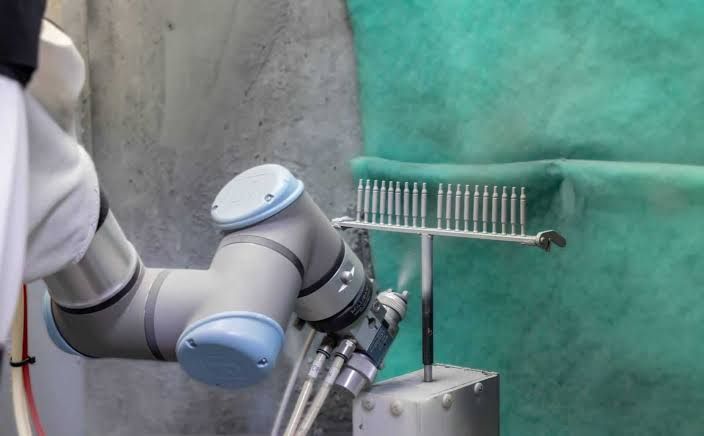
For spray systems, the material is atomized into droplets. For powder systems, electrically charged powder particles are directed toward the grounded component.
Application parameters such as pressure, flow rate, spray distance, gun movement, and application speed can influence the final coating.
5. Film Formation
After application, the coating must form a stable film. Liquid coatings may require solvent evaporation, chemical curing, or both.
Powder coatings generally require controlled heating to melt and cure the deposited powder.
6. Inspection and Quality Control
The finished coating is inspected to confirm that it meets defined specifications. Depending on the application, testing may include:
- Coating thickness
- Adhesion
- Gloss
- Color
- Surface appearance
- Hardness
- Chemical resistance
- Corrosion resistance
Manual vs. Automated Coating Systems
Manual systems rely on operators to control equipment movement and application parameters. They can provide flexibility when processing different component sizes and shapes.
Automated coating systems use programmed equipment, robots, reciprocators, or conveyorized production lines to provide more consistent application.
| Feature | Manual Systems | Automated Systems |
|---|---|---|
| Operator involvement | High | Lower |
| Flexibility | High | Moderate to high |
| Repeatability | Operator-dependent | Highly consistent |
| Production volume | Low to medium | Medium to high |
| Complex programming | Limited | Available |
| Process monitoring | Manual | Often integrated |
The appropriate approach depends on production volume, component geometry, coating requirements, and process objectives.
How to Select Coating Equipment
Selecting coating application equipment requires evaluating both the coating and the production environment.
Consider:
- Coating type: Liquid, powder, water-based, solvent-based, or specialty coating
- Substrate: Steel, aluminum, plastic, wood, composite, or another material
- Component size: Small parts may require different equipment from large structures.
- Required thickness: Equipment should support the target film thickness.
- Production volume: Higher throughput may justify automated systems.
- Surface geometry: Complex components may require specialized spray or application technologies.
- Curing requirements: Consider whether air drying, heat curing, UV curing, or another process is required.
- Maintenance: Equipment should be accessible for cleaning, inspection, and routine maintenance.
Best Practices for Consistent Coating Application
Consistent results depend on more than the application device itself. The complete process should be controlled from preparation through curing.
Useful practices include:
- Maintain consistent coating viscosity.
- Keep application equipment clean.
- Verify pressure and flow settings regularly.
- Maintain the recommended spray distance.
- Control application speed.
- Prepare surfaces according to coating specifications.
- Monitor environmental conditions where relevant.
- Measure coating thickness during quality checks.
- Follow manufacturer technical documentation.
Proper process control can reduce coating defects and improve repeatability across production batches.
Who Uses Coating Application Equipment?
Industrial manufacturers, coating contractors, automotive producers, metal fabricators, machinery manufacturers, aerospace companies, and infrastructure operators can use different types of coating application equipment.
The equipment configuration varies significantly between industries. A high-volume manufacturing line may use automated spray equipment, while a smaller operation may require flexible manual systems.
Frequently Asked Questions
What is coating application equipment?
Coating application equipment includes machines and tools used to distribute paint, powder, or protective coating materials onto a surface. Examples include spray guns, pumps, powder guns, dipping systems, and automated coating lines.
What are the main types of coating application equipment?
Common types include liquid spray systems, powder coating equipment, dipping systems, roller coaters, curtain coaters, and automated robotic application systems.
How does industrial spray coating equipment work?
Industrial spray equipment delivers coating material through a spray device that atomizes or disperses the material onto a prepared surface. Pressure, flow, spray pattern, and application distance influence the resulting coating.
What factors affect coating application quality?
Coating viscosity, surface preparation, equipment settings, application speed, film thickness, environmental conditions, and curing conditions can all affect application quality.
When should coating application be automated?
Automation can be appropriate when production volumes, repeatability requirements, component consistency, or process-control requirements justify automated equipment. The decision depends on the specific manufacturing process.
Conclusion
Coating application equipment provides the technology needed to transfer protective and decorative coatings onto industrial surfaces with controlled coverage and thickness. Spray systems, powder coating equipment, dipping systems, and automated application lines each have different operating principles and applications.
Choosing the right equipment requires consideration of the coating material, substrate, component geometry, production volume, film requirements, and curing process. When these factors are aligned, manufacturers can establish a more consistent and controlled coating process.