Granulation Tools and Equipment: Types, Uses and Selection
Granulation tools and equipment are widely used in industries that process powders into larger, more uniform particles.
Granulation can improve powder handling, reduce dust, enhance flow characteristics, and create material with more consistent physical properties.
These systems are particularly important in pharmaceutical manufacturing, chemical processing, food production, fertilizers, ceramics, and other industrial applications. Selecting the appropriate equipment depends on material characteristics, required particle size, moisture content, production capacity, and the desired granulation method.
What Is Granulation?
Granulation is a particle-size enlargement process in which fine powders or smaller particles are converted into larger granules. The process can involve moisture, binders, pressure, mechanical force, heat, or a combination of these factors.
The resulting granules can have improved:
- Flowability
- Handling characteristics
- Uniformity
- Bulk density
- Dust control
- Compressibility
- Storage properties
The exact characteristics depend on the material and the granulation process used.
Types of Granulation Processes
There are several granulation methods, but wet and dry granulation are among the most widely used.
Wet Granulation
Wet granulation uses a liquid, often combined with a binder, to help powder particles adhere to one another.
The general process includes:
- Powder blending
- Binder or liquid addition
- Wet mass formation
- Granule formation
- Drying
- Sizing
- Final blending or processing
Wet granulation is widely used when improved particle cohesion and flow are required.
Dry Granulation
Dry granulation forms granules without adding a liquid binder. Mechanical pressure is used to compact powder into larger structures, which are then reduced to the desired particle size.
Common dry granulation approaches include:
- Roller compaction
- Slugging
- Milling and sizing
Dry granulation can be useful for materials that are sensitive to moisture or heat.
Major Granulation Tools and Equipment
Different granulation applications require different machines. Equipment selection should be based on the material and the characteristics required in the final granules.
High Shear Granulator
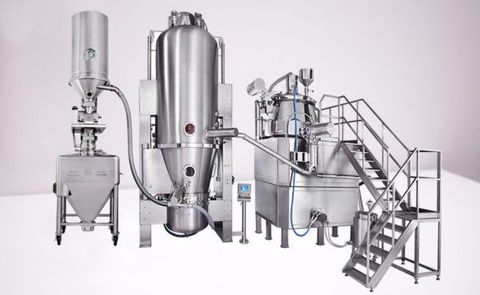
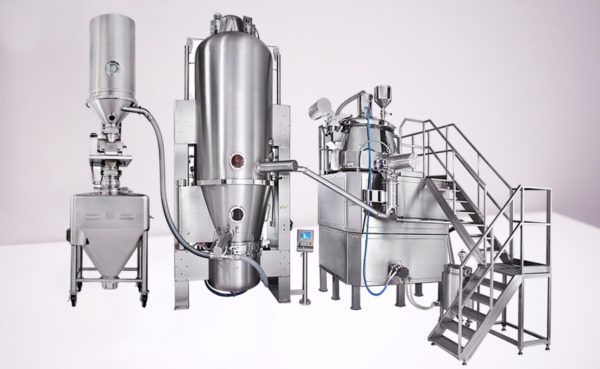
A high shear granulator uses an impeller and other mechanical components to mix powders and promote granule formation.
These machines can provide intensive mixing and rapid granulation. They are commonly used in pharmaceutical and chemical processing where controlled granule characteristics are important.
Fluid Bed Granulator
Fluid bed granulation combines particle fluidization with liquid spraying and controlled drying. Air passes through the material while a liquid binder can be introduced through spray nozzles.
The process can combine several operations within one system, depending on the equipment configuration.
Roller Compactor
Roller compactors are commonly associated with dry granulation. Powder passes between rotating rolls and is compressed into ribbons or compacted material.
The compacted material can then be milled into granules with the desired particle-size distribution.
Oscillating Granulator
Oscillating granulators use a rotating or oscillating mechanism to pass material through a screen. They can be used for wet or dry sizing applications depending on the configuration.
These systems are useful when controlled particle reduction is required after an initial granulation stage.
Cone Mill
A cone mill reduces oversized material and helps produce a more consistent particle-size distribution. It can be integrated into granulation lines as a sizing or milling stage.
Rapid Mixer Granulator
A rapid mixer granulator combines intensive mixing with controlled liquid addition to produce wet granules. The high-speed mixing action helps distribute binder and promote particle agglomeration.
Comparison of Granulation Equipment
The following table provides a general comparison of common equipment types.
| Equipment | Typical Process | Main Function | Common Applications |
|---|---|---|---|
| High Shear Granulator | Wet | Mixing and granule formation | Pharmaceutical, chemical |
| Fluid Bed Granulator | Wet | Granulation and drying | Pharmaceutical, food |
| Roller Compactor | Dry | Powder compaction | Pharmaceutical, chemical |
| Oscillating Granulator | Wet/Dry | Particle sizing | Pharmaceutical, industrial |
| Cone Mill | Wet/Dry | Milling and sizing | Powder processing |
| Rapid Mixer Granulator | Wet | Intensive mixing and granulation | Pharmaceutical, chemical |
Industrial Granulation Equipment Applications
Industrial granulation equipment is used across numerous processing environments.
Pharmaceutical Manufacturing
Pharmaceutical granulation equipment can be used to improve the flow, density, and compressibility of powders before tablet compression or other downstream operations.
Granulation parameters must be carefully controlled because particle characteristics can influence subsequent processing and finished-product consistency.
Chemical Processing
Chemical manufacturers may use granulation systems to convert powders into easier-to-handle particles. Granules can provide improved flow and reduced airborne dust compared with very fine powders.
Fertilizer Production
Granulation is widely used in fertilizer manufacturing to create particles with controlled size and physical characteristics. Equipment selection depends on formulation, moisture, production capacity, and desired granule structure.
Food Processing
Food ingredients can be granulated to improve handling, dissolution, flow, or blending characteristics. Hygienic design and material compatibility are particularly important in food-processing environments.
Industrial Minerals
Minerals and other inorganic materials may be granulated to improve transportation, storage, feeding, or downstream processing characteristics.
Factors to Consider When Selecting a Granulation Machine
Choosing a granulation machine requires evaluation of both the material and the production process.
Material Properties
Consider:
- Particle size
- Moisture sensitivity
- Bulk density
- Flowability
- Cohesiveness
- Compressibility
- Thermal sensitivity
- Chemical characteristics
Materials with significantly different properties may require different granulation technologies.
Desired Granule Size
The target particle-size distribution is an important selection factor. Equipment should be capable of producing the required granule dimensions consistently.
Production Capacity
Production requirements influence machine size, processing configuration, batch size, and automation requirements.
Moisture Requirements
If the material cannot tolerate moisture, dry granulation may be more appropriate. Materials that benefit from liquid binders may require wet granulation technology.
Cleaning and Maintenance
For regulated environments, equipment should be designed to support effective cleaning and inspection. Accessible components and suitable construction materials can simplify routine maintenance.
Pharmaceutical Granulation Equipment Considerations
Pharmaceutical applications often have stricter requirements than general industrial powder processing.
Pharmaceutical granulation equipment may need to support:
- Controlled processing parameters
- Hygienic construction
- Repeatable batch processing
- Contamination control
- Cleaning procedures
- Documentation requirements
- Particle-size consistency
Equipment materials and surface finishes should also be compatible with the product and cleaning methods.
Granulator Equipment Automation
Modern granulator equipment can incorporate sensors, programmable controls, automated material handling, and process monitoring.
Automation can help control parameters such as:
- Mixing time
- Impeller speed
- Liquid addition rate
- Temperature
- Airflow
- Pressure
- Moisture
- Drying time
Data collection can also help operators identify process variations and maintain more consistent production conditions.
Common Granulation Challenges
Granulation processes can encounter several technical challenges.
Inconsistent Particle Size
Variation in mixing, binder distribution, compaction, or milling can result in an uneven particle-size distribution.
Over-Wetting
In wet granulation, excessive liquid can produce large, dense agglomerates that may be difficult to dry or process.
Under-Granulation
Insufficient binder distribution or mechanical energy can result in weak granules with poor structural integrity.
Excessive Fines
Incorrect milling or process conditions can produce excessive fine particles. Process optimization and appropriate sizing equipment can help address this issue.
How to Improve Granulation Processing
A consistent process starts with clearly defined material and product requirements.
Useful practices include:
- Characterize the raw material before selecting equipment.
- Define the target granule size and acceptable particle distribution.
- Control critical process parameters consistently.
- Validate equipment settings for the intended material.
- Monitor moisture and temperature where applicable.
- Inspect granule quality at defined production stages.
- Maintain equipment regularly to prevent mechanical variation.
- Document process conditions for repeatability.
Process optimization should be based on measurable results rather than relying only on machine specifications.
Choosing Granulation Equipment Manufacturers
When evaluating granulation equipment manufacturers, consider more than machine capacity.
Important criteria include:
- Experience with similar materials
- Equipment design and configuration
- Available processing technologies
- Automation capabilities
- Quality-control systems
- Equipment construction materials
- Cleaning requirements
- Maintenance support
- Spare-component availability
- Process-development capabilities
Testing representative material can also provide valuable information about whether a particular equipment configuration is appropriate.
Frequently Asked Questions
What are granulation tools and equipment?
Granulation tools and equipment are machines used to convert powders or fine particles into larger, more uniform granules. Common equipment includes high-shear granulators, fluid bed granulators, roller compactors, cone mills, and oscillating granulators.
What is the difference between wet and dry granulation?
Wet granulation uses liquid, often with a binder, to promote particle agglomeration. Dry granulation uses mechanical compression without adding liquid and is often suitable for moisture-sensitive materials.
What is a high shear granulator used for?
A high shear granulator provides intensive mixing and mechanical agitation to promote rapid granule formation. It is commonly used in pharmaceutical and chemical powder-processing applications.
How do I choose an industrial granulator machine?
Consider the material properties, desired granule size, production capacity, moisture sensitivity, processing method, cleaning requirements, automation needs, and downstream equipment compatibility.
What equipment is commonly used for pharmaceutical granulation?
Common equipment includes high-shear granulators, rapid mixer granulators, fluid bed granulators, roller compactors, cone mills, and other sizing systems. The appropriate combination depends on the formulation and process requirements.
Conclusion
Granulation tools and equipment provide essential capabilities for transforming fine powders into more manageable and consistent granules. Wet granulation, dry granulation, high-shear processing, fluid-bed systems, roller compaction, and milling technologies each serve different processing requirements.
The most suitable equipment depends on material properties, granule specifications, production capacity, moisture sensitivity, automation requirements, and quality expectations. A careful evaluation of these factors can help manufacturers establish a reliable granulation process and achieve consistent downstream performance.